← Back to homepage
Model Inference & Calibration
Using measurements to learn what cannot be measured directly
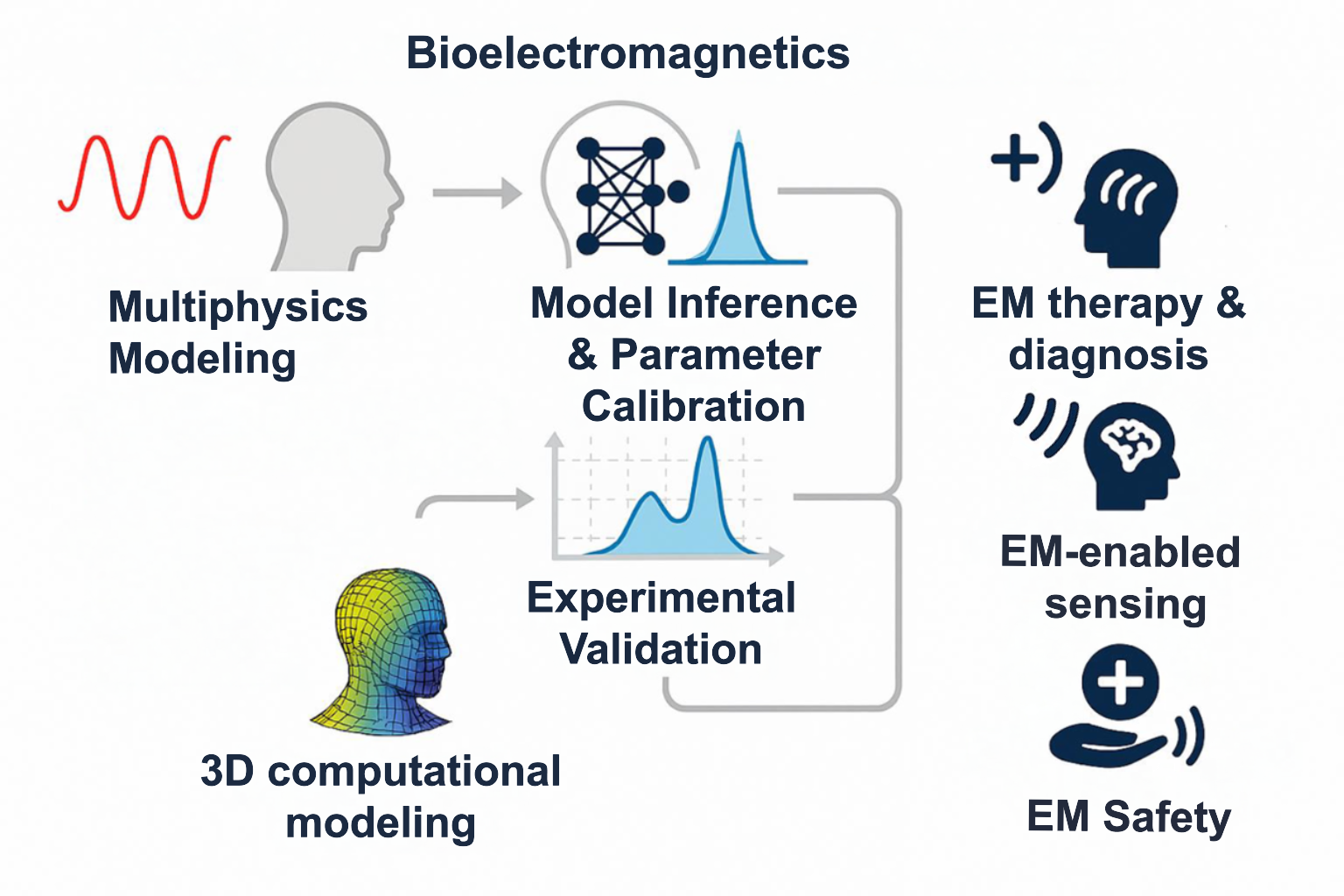
Biological systems are too complex to measure every relevant process directly. Model inference uses measurements to estimate properties that cannot be observed, such as blood perfusion, thermal and dielectric tissue properties or the energy actually delivered. Calibration makes sure computational models agree with reality.
Rather than building complete digital replicas, we aim for models that are accurate enough, interpretable and useful for scientific discovery, technology development and clinical decisions.
Why Inference Matters
Patients with similar characteristics can respond very differently to the same treatment. Part of the explanation lies in properties that differ between individuals but are invisible in standard images: how well a tumour is perfused, how tissue conducts electricity, how the body regulates temperature. Estimating these hidden properties is central to our question of why individuals respond differently. See the Research Vision.
Therapy as Experiment
Every treatment perturbs the body, and the response reveals information about the patient. In hyperthermia, the measured temperature rise reflects the delivered energy, the thermal properties and the perfusion. By combining invasive and MR temperature measurements with patient-specific simulations, we reconstruct 3D temperature distributions, optimise tissue properties and calibrate treatment planning on-line, the topic of an NWO Veni grant.
Similar ideas apply to MR-guided focused ultrasound, where periodic power modulation allows simultaneous estimation of SAR, thermal diffusivity and damping, and to temperature-based perfusion imaging.
Methods
We combine physics-based multiphysics models with estimation methods such as reduced-order models with Kalman filtering, parameter optimisation and polynomial chaos expansion for uncertainty quantification. On the imaging side, TiCEPT infers wideband electrical tissue properties from tissue composition measured with multinuclear MRI. Models are adapted to images acquired in treatment position to improve simulation-guided treatment.
Representative Publications
Accurate 3D Temperature Dosimetry During Hyperthermia Therapy by Combining Invasive Measurements and Patient-Specific Simulations
Verhaart RF, …, Paulides MM · International Journal of Hyperthermia, 2015 · Best physics paper 2015
DOI: 10.3109/02656736.2015.1052855
POD–Kalman Filtering for Improving Noninvasive 3D Temperature Monitoring in MR-Guided Hyperthermia
VilasBoas-Ribeiro I, …, Paulides MM · Medical Physics, 2022
DOI: 10.1002/mp.15811
Adapting Temperature Predictions to MR Imaging in Treatment Position to Improve Simulation-Guided Hyperthermia for Cervical Cancer
VilasBoas-Ribeiro I, …, Paulides MM · IEEE Open Journal of Engineering in Medicine and Biology, 2024
DOI: 10.1109/OJEMB.2023.3321990
TiCEPT: Wideband Electrical Properties Tomography by Tissue Composition Assessment With Quantitative Multinuclear MRI
Barendsz LJC, …, Paulides MM · Magnetic Resonance in Medicine, 2026
DOI: 10.1002/mrm.70139
MR Thermometry Accuracy and Prospective Imaging-Based Patient Selection in MR-Guided Hyperthermia Treatment for Locally Advanced Cervical Cancer
VilasBoas-Ribeiro I, …, Paulides MM · Cancers, 2021
DOI: 10.3390/cancers13143503
All selected publications
Frequently Asked Questions
What is model calibration in medicine?
Model calibration adjusts the parameters of a computational model, such as tissue properties, so that its predictions match measurements in the patient. A calibrated model predicts the effect of treatment changes more reliably.
What does "Therapy as Experiment" mean?
It is the idea that every treatment is also a measurement: by recording and modelling how a patient responds to an intervention, therapy can improve care and at the same time reveal patient-specific properties.