← Back to homepage
Computational Medicine
Patient-specific models that support treatment decisions
Computational medicine integrates measurements, medical imaging and physics-based simulations into models that support diagnosis, therapy planning and treatment optimisation. In biomedical electromagnetics, such models predict how electromagnetic fields and heat are distributed in an individual patient.
Our work has helped move these models from engineering design tools to clinically used treatment planning, and now towards patient-specific digital twins that are continuously compared with measurements.
Hyperthermia Treatment Planning
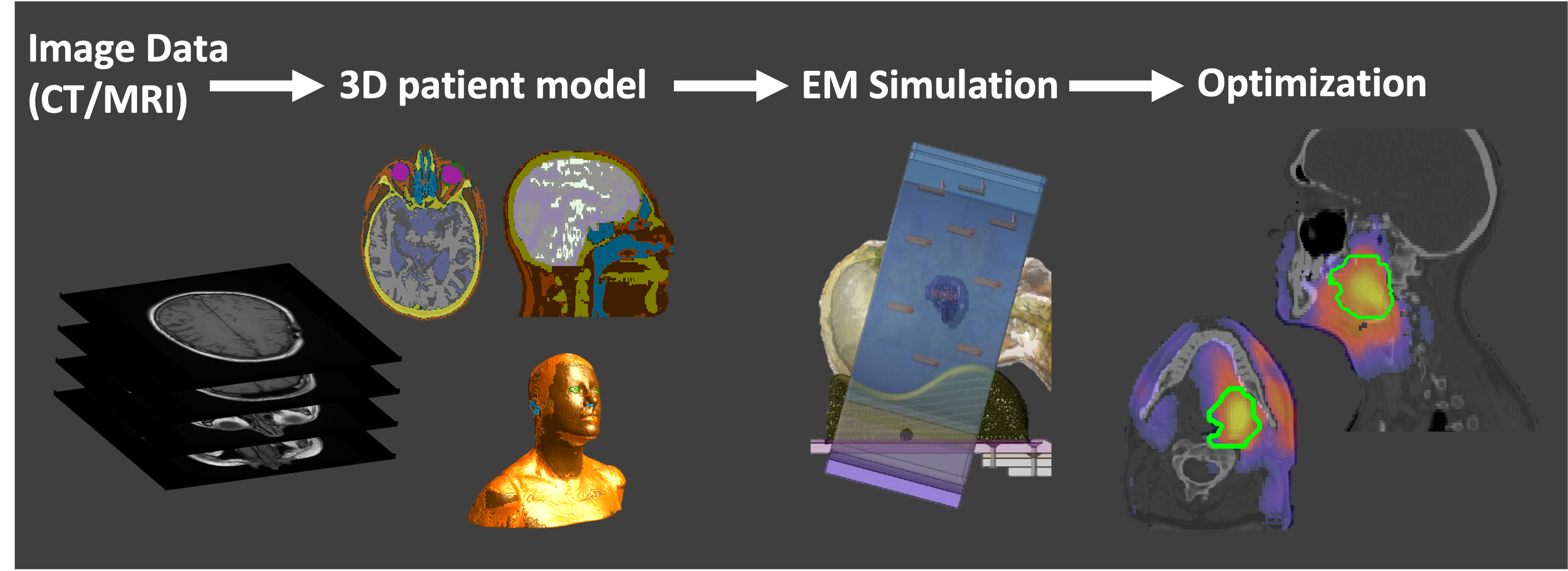
Hyperthermia treatment planning predicts the specific absorption rate (SAR) and temperature in a 3D patient model and optimises the antenna settings to focus heat on the tumour. We reviewed simulation techniques for treatment planning, contributed to its implementation in routine clinical care in Rotterdam, and helped develop a versatile deep hyperthermia treatment planning tool.
Treatment planning also drives device design: the HYPERcollar and HYPERcollar3D were designed with simulations, and planning guides the selection of the right applicator for each patient. See Hyperthermia & MR-Guided Therapy.
Patient Models and Benchmarks
A model is only as good as its anatomy and tissue properties. We developed automatic segmentation, studied how many tissues need to be distinguished, modelled discrete vasculature and evaluated thermal tissue models. To make results comparable between groups, we led the ESHO benchmarks for computational modelling and optimisation in hyperthermia and introduced the Erasmus Virtual Patient Repository with standardised patient models.
Uncertainty and Validation
Tissue properties, patient position and perfusion are never known exactly. We use polynomial chaos expansion to quantify how such uncertainties affect predictions, both in head and neck hyperthermia and in neuromodulation, and we validate models against measurements in phantoms and patients.
From Planning to Control and Digital Twins
The next step is models that update during treatment. Combining simulations with MR thermometry and feedback control, for example model predictive control and Kalman filtering, enables adaptive treatment. Patient-specific models that are continuously calibrated with measurements are what we call BioEM digital twins. See Model Inference & Calibration.
Representative Publications
Simulation Techniques in Hyperthermia Treatment Planning
Paulides MM, Stauffer PR, Neufeld E, …, van Rhoon GC · International Journal of Hyperthermia, 2013
DOI: 10.3109/02656736.2013.790092
ESHO Benchmarks for Computational Modeling and Optimization in Hyperthermia Therapy
Paulides MM, Rodrigues DB, Bellizzi GG, …, Dobsicek Trefná H · International Journal of Hyperthermia, 2021
DOI: 10.1080/02656736.2021.1979254
Development of a Versatile Deep Hyperthermia Treatment Planning Tool
Drizdal T, Paulides MM, …, van Rhoon GC · Physica Medica, 2025
DOI: 10.1016/j.ejmp.2025.105035
Uncertainty Analysis in Hyperthermia Treatment Planning for Head & Neck Cancer Using Polynomial Chaos Expansion
Kwakernaak RC, Zanoli M, Perkó Z, Paulides MM, Curto S · Physics in Medicine & Biology, 2026
DOI: 10.1088/1361-6560/ae399e
Implementation of Treatment Planning in the Routine Clinical Procedure of Regional Hyperthermia Treatment of Cervical Cancer: An Overview and the Rotterdam Experience
Canters RAM, Paulides MM, Franckena M, van der Zee J, van Rhoon GC · International Journal of Hyperthermia, 2012
DOI: 10.3109/02656736.2012.675630
Accurate 3D Temperature Dosimetry During Hyperthermia Therapy by Combining Invasive Measurements and Patient-Specific Simulations
Verhaart RF, …, Paulides MM · International Journal of Hyperthermia, 2015 · Best physics paper 2015
DOI: 10.3109/02656736.2015.1052855
All selected publications
Frequently Asked Questions
What is hyperthermia treatment planning?
Hyperthermia treatment planning uses a 3D model of the patient, built from CT or MRI, to simulate how electromagnetic energy is absorbed and how tissue heats. It is used to choose antenna settings that focus heat on the tumour while protecting healthy tissue.
What is a digital twin in medicine?
A medical digital twin is a patient-specific computational model that is continuously updated with measurements from that patient. In our work, such BioEM digital twins combine imaging, electromagnetic and thermal models with measurements during treatment to predict and adapt the treatment.