← Back to homepage
EM Measurements & Dosimetry
Measuring electromagnetic fields to make medical devices and wireless technology safe
Quantitative electromagnetic measurements are the foundation for dosimetry, quality assurance and safety. They verify that a hyperthermia applicator delivers the intended field, validate computational models, and show how much radiofrequency energy people absorb from medical devices and wireless technology.
Our work ranges from robotic field scanning and reconstruction to exposure assessment that has informed national and international safety guidelines.
Quality Assurance of Hyperthermia Devices
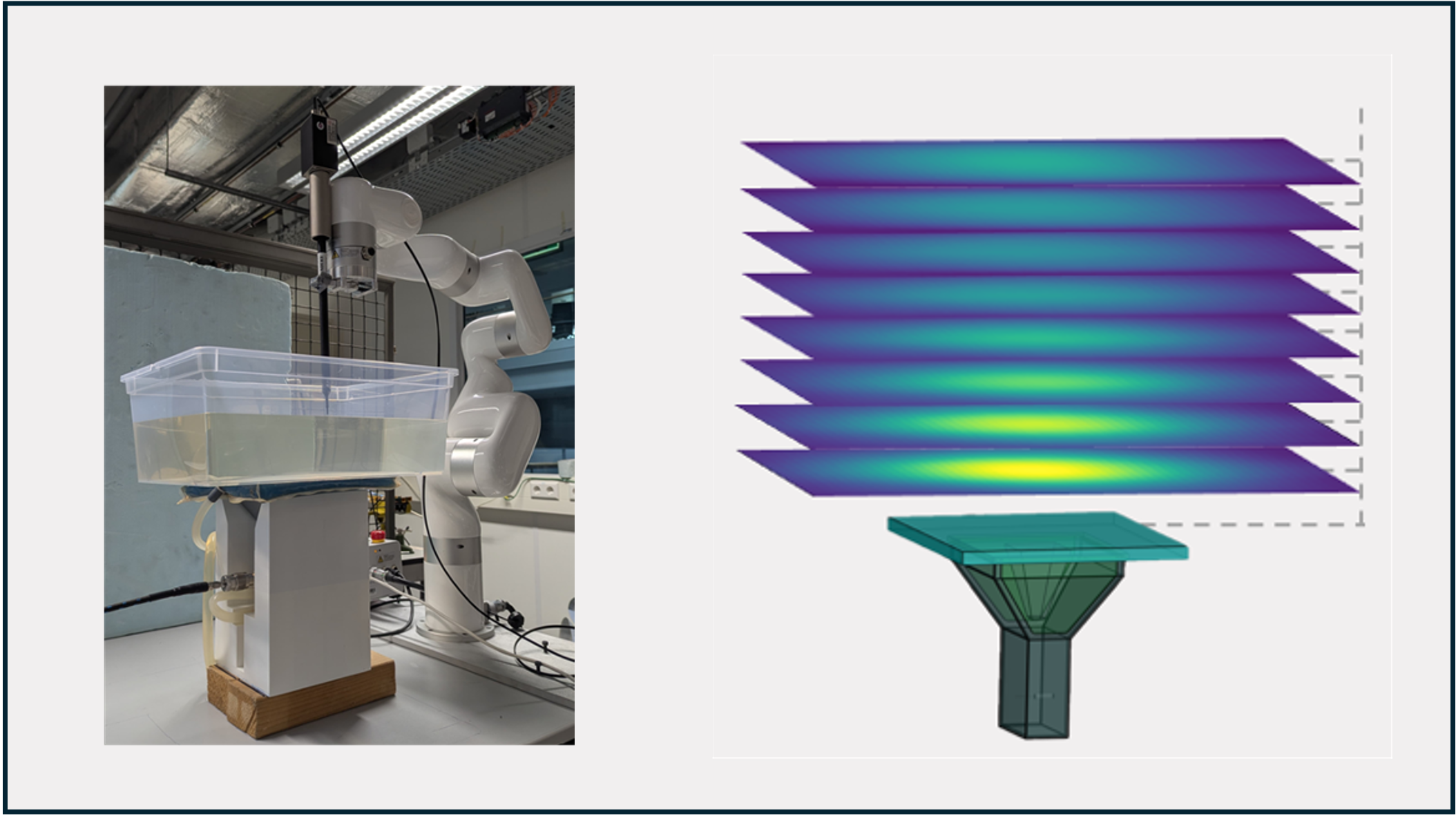
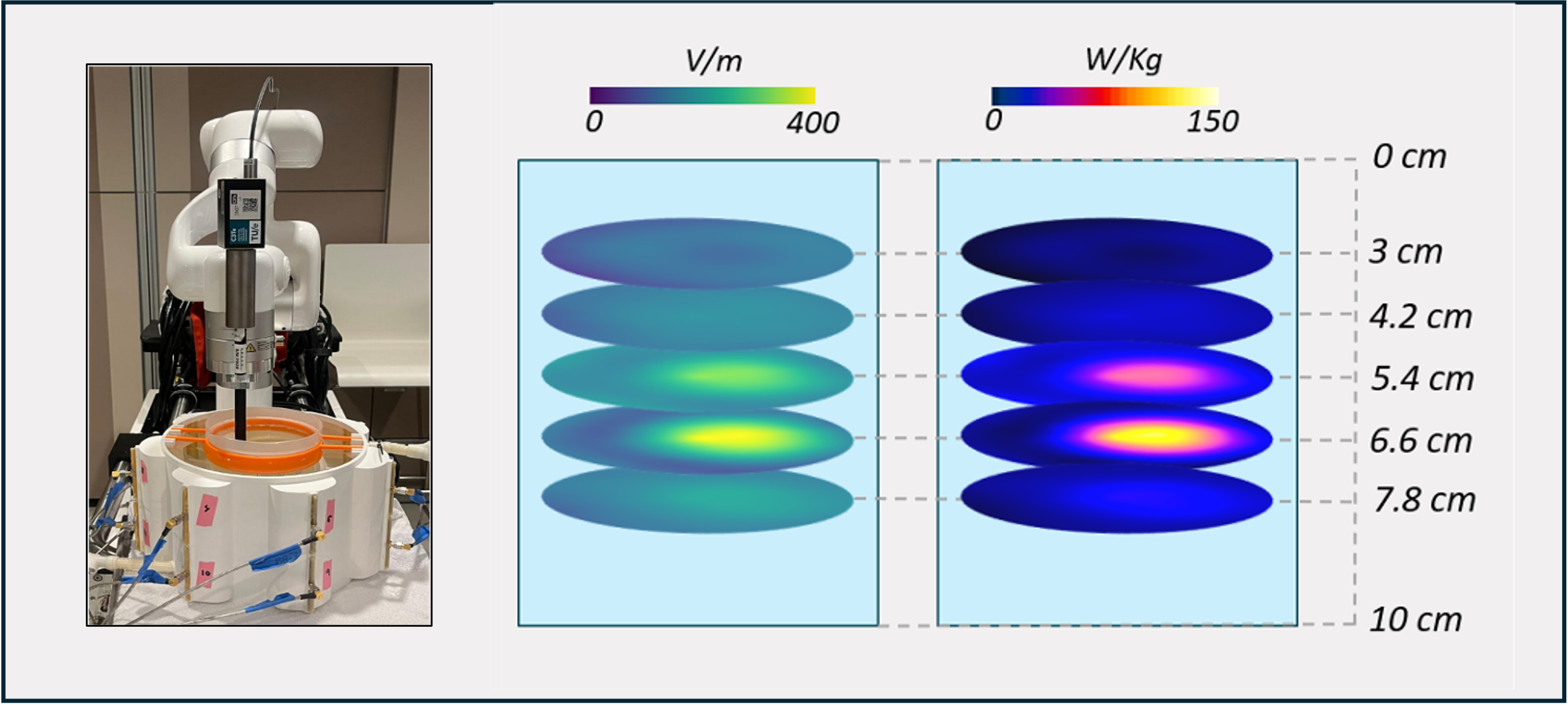
Before an applicator is used on patients, its field must be checked. Full volumetric scans are slow, so we developed compressed sensing methods that reconstruct the 3D electric field from far fewer measurement points, making routine clinical quality assurance faster. Related work includes automated volumetric field scanning, dosimetry from near-field measurements on a Huygens box around an antenna, photogrammetry for quality control and low-cost electric field probes. See Hyperthermia & MR-Guided Therapy.
RF Exposure and Safety
People are exposed to radiofrequency electromagnetic fields (RF-EMF) from mobile phones, wireless networks and medical equipment. We assessed exposure of children and adults at the ICNIRP reference levels, the influence of head anatomy on brain SAR from mobile phones, and exposure of patients and staff during hyperthermia. Clinical hyperthermia data provide rare evidence on the effects of intense RF exposure in humans, such as the absence of acute ocular damage, and were used to propose SAR thresholds based on thermal dose.
Maarten Paulides served on the permanent EMF committee of the Health Council of the Netherlands and in the Scientific Expert Group of ICNIRP (2017–2021), which prepared new high-frequency exposure guidelines with the WHO. Current work in the Horizon Europe project ETAIN studies RF exposure from 2G to 5G technologies and of other species, such as insects.
Representative Publications
Compressed Sensing Based Optimization of Electromagnetic Field Measurements Required for Quality Assurance of Hyperthermia Applicators
Phal DD, Sumser K, Curto S, Paulides MM · Physics in Medicine & Biology, 2025
DOI: 10.1088/1361-6560/ae2aa3
Dosimetry Computation Based on Near-Field Measurements on a Huygens Box Surrounding the Antenna
EuCAP 2025
Publisher record
Impact of Head Morphology on Local Brain Specific Absorption Rate From Exposure to Mobile Phone Radiation
Adibzadeh F, Bakker JF, Paulides MM, Verhaart RF, van Rhoon GC · Bioelectromagnetics, 2015
DOI: 10.1002/bem.21885
Accurate 3D Temperature Dosimetry During Hyperthermia Therapy by Combining Invasive Measurements and Patient-Specific Simulations
Verhaart RF, …, Paulides MM · International Journal of Hyperthermia, 2015
DOI: 10.3109/02656736.2015.1052855
All selected publications
Frequently Asked Questions
What is SAR?
The specific absorption rate (SAR) is the rate at which the body absorbs electromagnetic energy, in watts per kilogram. It is used both to plan hyperthermia treatments and to set safety limits for exposure to radiofrequency fields.
Why do hyperthermia devices need quality assurance?
The field an applicator produces can drift because of hardware, positioning or water bolus differences. Regular measurements verify that patients receive the intended heating; compressed sensing makes these checks faster.