Note: CICL/e now continues as the Taskforce Implementation of the Eindhoven MedTech Innovation Center (e/MTIC). See Implementation & Innovation.
Introduction
Healthcare is becoming increasingly expensive. To ensure broad access, cost reductions and efficiency gains are critical. While innovation has led to improved outcomes, accessibility and affordability remain major bottlenecks. Regional hospitals face growing demand and struggle to scale care delivery. To ensure sustainable healthcare, we must rethink how innovations are prioritized, implemented, and scaled for impact.
CICL/e – Center for Impact in Clinical Care Eindhoven
Given the challenges faced in terms of accessibility and affordability, Máxima Medical Center (MMC), Catharina Hospital Eindhoven (CHE), Kempenhaeghe (KH) and Eindhoven University of Technology (TU/e) have initiated a new collaborative initiative, named CICL/e, to systematically address structural challenges in regional care delivery. CICL/e aims to integrate clinical expertise, engineering innovation, and translational research to develop and implement scalable, technology-enabled care models. The collaboration leverages the Brainport Eindhoven ecosystem to enhance the scalability and impact of solutions, aiming to mitigate workforce shortages, rising costs, and demographic pressures.
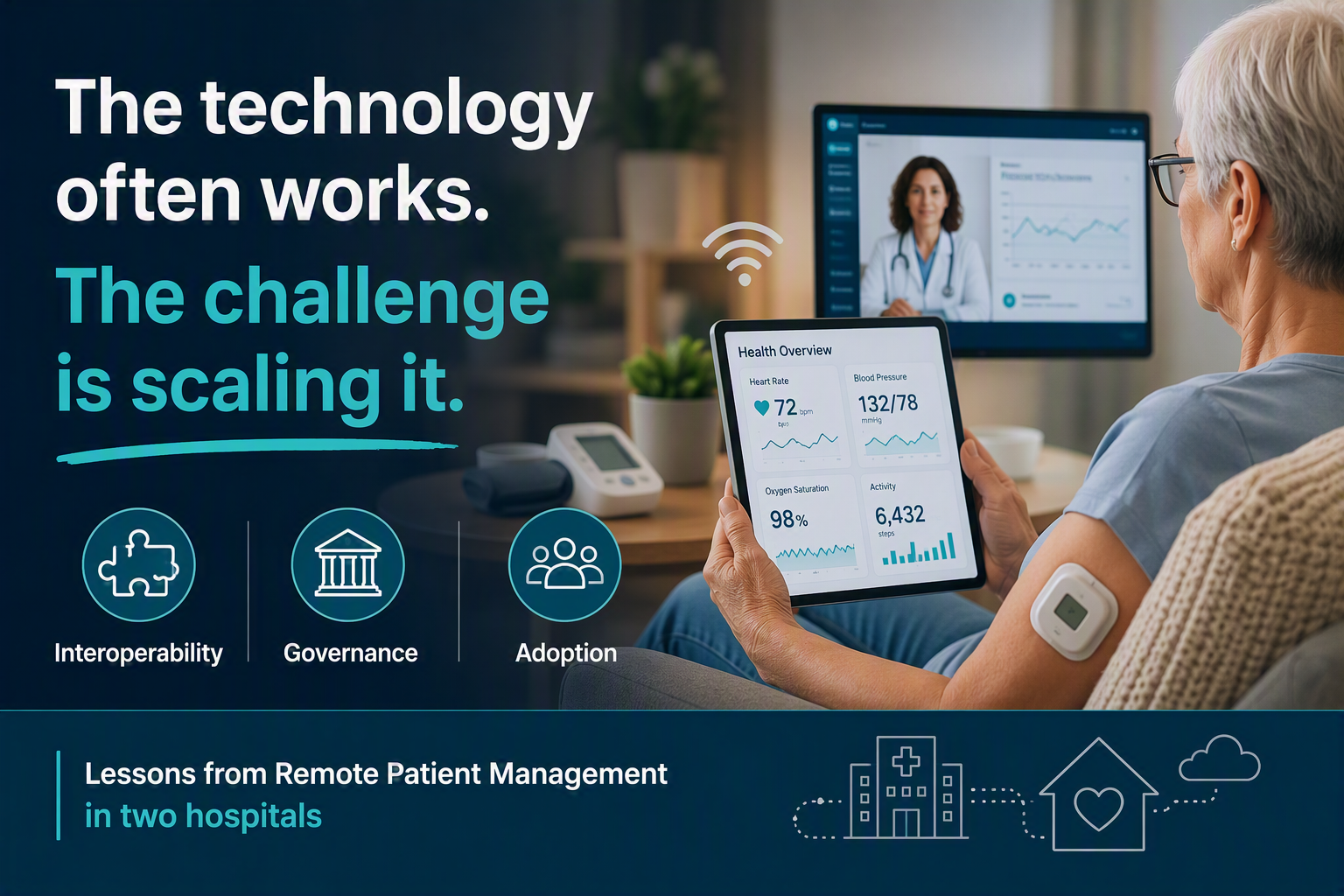
Implementing new medical technologies is complex, with multiple hurdles hindering timely, impactful uptake. CICL/e's emphasis on implementation science and high-volume applicability aligns with the goals of remote patient management (RPM). Hence two RPM pilots were selected for exploring the hurdles of sustainable, patient-centered care transformation.
The Promise of Remote Patient Management (RPM)
RPM (Remote Patient Management, not to be confused with Remote Patient Monitoring) refers to technology-enabled remote care delivery, rather than just surveillance or data collection. RPM holds substantial promise for improving care delivery, particularly by enhancing accessibility and affordability. By empowering stable patients to take over certain tasks from healthcare professionals, RPM supports more efficient resource use. Furthermore, it enables the concept of "virtual beds," allowing patients to be clinically admitted at home through continuous monitoring and guided interventions. In doing so, it can reduce unnecessary hospital readmissions, particularly by facilitating earlier detection of clinical deterioration. Moreover, sensor-based diagnostics integrated within RPM strategies can replace or complement traditional diagnostics, thereby lowering the burden on in-hospital diagnostic facilities. Finally, by leveraging data, predictive analytics, and automation, RPM enhances care delivery and improves personalization, efficiency, and overall quality of care.
Objective
This white paper explores the hurdles of implementing new technology through the lens of the two pilot implementations, enhanced with a broader, person-centered future vision on RPM. The main objective of the implementation projects described in this paper was to identify the key facilitators and barriers for successful scaling of RPM care pathways, and to use these insights to inform a methodology for the design of scalable, person-centered RPM solutions.
Case Descriptions
The two pilot projects described in this paper were selected through a structured process by a multidisciplinary expert group within CICL/e. Selection criteria included clinical maturity, relevance across institutions, technical feasibility, and the potential to generate broader learnings. Rather than choosing the most advanced solutions, the emphasis was on identifying complementary cases that could reveal different types of hurdles in implementing RPM at scale.
The selected pilots—one from Catharina Hospital (CHE), focused on post-bariatric surgery monitoring, and one from Máxima MC (MMC) on continuous monitoring in chronic heart failure—each represented a different care context and implementation stage. The ambition was not only to evaluate them locally, but to explore possibilities for cross-implementation and shared scaling strategies.
Evaluation and reflection were supported by the CICL/e environment, which brings together clinical, technological, infrastructural, and organizational expertise. This allowed the pilots to function as testbeds for identifying real-world barriers and building transferable insights, not just about the technologies involved, but mainly about the systemic conditions required for success.
Remote Monitoring for Bariatric Surgery (CHE)
At CHE, the focus was on optimizing post-operative care after bariatric surgery. The aim was to detect post-surgical complications earlier, supporting safe early discharge and reducing in-hospital stay. The solution, in-hospital and, subsequently, home-based monitoring by the Healthdot wearable sensor, was embedded within the hospital's existing Same Day Discharge (SDD) protocol. Prior literature already demonstrated its feasibility and acceptability (van Ede et al., 2023). By the time of evaluation, implementation at CHE had reached a stable SDD percentage of over 30% of eligible cases, offering a valuable learning environment.
A previous study performed at CHE demonstrated both the safety of performing outpatient bariatric surgery as well as the feasibility of RPM to continuously monitor patients at home (van Ede et al., 2023). A clinically tested and validated RPM device was available (van der Stam et al., 2022) and, importantly, the business case proved positive, so the project proposal was submitted to the "Project Portfolio Commissie", the CHE cross-functional review process. Each hospital has a slightly different approval process, so in order to implement the RPM solution for bariatric surgery in Máxima MC, the process has to go through the same steps.
Continuous Monitoring for Heart Failure Patients (MMC)
At MMC, the focus was on chronic heart failure, a disease characterized by frequent hospitalizations due to exacerbations that are often preventable by early detection and management of deterioration. Traditional RPM programmes typically rely on once-daily spot measurements of symptoms, blood pressure, heart rate, and weight, but these are relatively late indicators of deterioration. However, recent studies show that continuous heart rate monitoring, assessing changes in the circadian rhythm, generates an earlier and more accurate prediction of deterioration, providing a larger window for timely interventions to prevent readmission (van Es et al., 2025). Therefore, this project aimed to implement continuous heart rate monitoring to assess circadian rhythm changes in the existing heart failure RPM routine.
Over several months, the team developed a complete care pathway using the Metromap method, defined a detailed program of requirements, and performed a market scan. An initial solution based on the potential integration of a wearable wrist-worn sensor (Corsano) with the RPM platform (Luscii) proved unworkable due to API limitations and structural costs. As of June 2025, a strategic reassessment was performed focusing on an alternative MDR-certified sensor (Movesense) with the possibility of direct coupling to a cloud solution.
Results and Learnings – Hurdle Clusters
Both use cases, heart failure and bariatric surgery, highlight how promising innovations can falter under real-world implementation pressure. In the heart failure project, we encountered several systemic barriers: most notably, the absence of suitable MDR-certified devices ready for long-term use, interoperability issues (particularly with Luscii), and a lack of automated data interpretation. A significant challenge was the high cost of wearable devices and unclear reimbursement structures. As documented in a financial assessment, projected returns were too uncertain to justify continuation. A second attempt using the Movesense sensor revealed similarly low readiness for integration: while the device itself was certified and affordable, the supporting software ecosystem (apps, interfaces, analytics) was immature, and self-development would require resources, possibly certification, and expertise that were not available within the institution. Despite a motivated lead physician and institutional interest in data platform development, the sensor was not considered suitable by MMC for implementation in the current environment.
The bariatric case, though seemingly straightforward, proved similarly fragile. What was intended as a replication of a proven use case in a neighbouring hospital revealed deeper systemic issues. Even with established clinical relevance and positive results elsewhere, a local business case was still required—emphasizing that copy-paste scaling is often infeasible. Minor differences in workflows necessitated a new process design, and the perceived gains were small: in one hospital, much of the length-of-stay reduction had already been achieved, while the other limited its implementation to only a subset of patients. Despite having enthusiastic clinical leads in both hospitals and preliminary technical feasibility, the project was ultimately stalled due to low institutional prioritization, slow development of the business case, and the absence of integration into hospital-wide strategy.
Cumulative lessons
Taken together, these cases reveal a pattern of hurdles that go beyond individual projects:
- Dependence on champions: When implementation success hinges on a single enthusiastic physician, there is little resilience or institutional ownership.
- Fragmented infrastructures: Limited interoperability between devices, platforms, and clinical systems not only makes technical integration cumbersome and costly but also imposes systemic costs on individual projects.
- Narrow business cases: Requiring individual cost-benefit analyses for each micro-innovation undermines the potential to learn and scale systematically.
- Misalignment with organizational strategy: Even when innovation is supported at the board level, it rarely translates into shared priorities or protected capacity at the operational level.
- Lack of modularity and reusability: Projects are treated as one-offs, and lessons learned are not easily transferred.
Discussion
From Individual Projects to System Learning
The specific implementation challenges we encountered in these two pilots, though context-dependent, highlight systemic barriers that are likely to arise in many RPM initiatives. They reveal what happens when the abstract ambition of scalable RPM meets the concrete realities of hospital IT systems, procurement logic, and organizational priorities. Fragmentation, lack of interoperability, and siloed funding mechanisms continue to block the transition to data-driven, person-centered care. Despite strong clinical rationale and system-level benefits, implementation remains difficult when real-world projects confront technical limitations, rigid reimbursement structures, and inconsistent institutional engagement.
In both pilots, we observed a dependence on enthusiastic individuals. While this can catalyse innovation, it also makes success fragile. Structural embedding, through strategy, governance, and resourcing, is often lacking. Even when governance-level support exists, it rarely translates into clear operational priorities, resulting in slow or stalled progress. Some of the challenges described, such as limited interoperability, vendor lock-in, or the need for robust business cases, could have been anticipated from the outset. Indeed, CICL/e was set up precisely because such barriers are well known in theory. However, the pilots served to expose how these barriers manifest in concrete settings, and how difficult they are to overcome in practice, even with strong initial intentions. That is the core value of this program: learning by doing. Rather than solving everything on paper, CICL/e aims to create learning environments that bring latent frictions to the surface and turn them into actionable insights.
Inherently, this way of learning through real-world experimentation also entails challenges, as it inevitably involves uncertainty about feasibility, stakeholder alignment, and ultimate success. For instance, in the heart failure pilot, trying to combine multiple preconditions—low cost, MDR certification, Luscii integration, scalability—proved overly restrictive. No available device could meet all requirements simultaneously. Similarly, in the bariatric pilot, the requirement for a new business case—even when robust data from a neighboring hospital were available—slowed implementation significantly.
These cases illustrate a recurring mismatch: while the potential value of RPM is often realized at the system level (e.g., fewer hospitalizations, better outcomes), the associated costs and uncertainties are borne at the institutional or departmental level. This structural misalignment weakens the incentive to invest money and resources, even when benefits are likely in the long term. Our pilots show that unless this misalignment is actively addressed, by separating short-term institutional risk from long-term system value, promising RPM use cases will remain stuck in experimentation. This insight directly informed the need for infrastructure pilots and regional governance models, as outlined below.
Rather than treating these setbacks as failures, we propose to reframe them as infrastructure pilots. The aim is not merely implementation, but capability building: establishing the technical, organizational, and governance prerequisites for future RPM at scale. In some cases, this may justify the temporary use of non-integrated platforms or non-MDR devices under strict conditions. A phased approach—starting with data collection, followed by clinical interpretation and eventual integration—can lower the threshold for experimentation while maintaining safety and accountability.
A key insight from both pilots is that attempting to integrate every component of RPM into existing platforms from the outset may be unrealistic. In the heart failure case, integration with the RPM platform Luscii proved unfeasible: API access was restricted, wearable apps did not provide the required physiological parameters, and connectivity between Luscii and the hospital's EHR was limited. In the bariatric case, the wearable platform used at CHE was a standalone solution, which MMC does not permit under current IT policy. These constraints made full integration both costly and rigid.
An alternative approach would be to begin with a lightweight architecture, where wearable data is ingested directly via secure cloud services, processed locally or within a hospital-controlled environment, and only the derived insights are pushed into the EHR. While this requires internal data analytics capacity, it avoids substantial platform licensing costs and gives hospitals greater control over which wearables and algorithms to adopt. In the long term, this strategy lays the foundation for a sustainable and future-proof RPM infrastructure; one that is open to third-party innovation and supports modular, AI-driven decision support.
Next steps towards person-centered, scalable RPM
The insights gained from the pilots, particularly regarding integration constraints, platform rigidity, and institutional incentives, underscore the need to reframe RPM as a system capability rather than an app or product. To overcome current barriers, RPM must evolve from isolated pilots into an integrated, regionally coordinated care infrastructure. Instead of fragmented, disease-specific programs, the system must address clusters of frequently co-existing diseases and comorbid conditions. Realizing RPM as a system capability will require open, modular platforms that allow seamless plug-in of wearables, algorithms, and decision tools from multiple vendors. To improve engagement, patients must have real-time access to their data, with feedback loops that support understanding, motivation, and self-management. Use cases should expand beyond heart failure and bariatrics into perioperative care, oncology, perinatal care, and other domains.
A critical enabler of this transformation is the contribution of academic and industrial partners. TU/e, together with e/MTIC and the wider Brainport ecosystem, is well positioned to bridge clinical needs and technical innovation. This includes:
- Algorithm development and AI tooling for early detection, triage, and decision support
- Re-engineering existing wearables to align with clinical requirements and interoperability standards
- Designing new RPM components where no suitable solutions exist, leveraging TU/e's expertise in system architecture, biomedical engineering, and human-technology interaction
In addition, our region provides a real-world testbed for embedded innovation. By combining regional care networks with academic and industrial R&D capacity, we can accelerate the shift from fragmented experimentation to coordinated infrastructure-building. This ecosystem is ideally suited to develop a sustainable RPM foundation, one that is open to continuous improvement by third-party developers, whether in hardware, software, or AI.
To operationalize this vision, we propose three strategic tracks:
- Healthcare institution-led development. Allocate protected budget and internal capacity to build an interoperable RPM infrastructure. Begin with high-impact use cases and expand iteratively.
- Partnership-based co-development. Collaborate with selected technology partners to develop modular components (e.g., device-agnostic interfaces, patient dashboards, explainable AI), possibly under shared governance.
- Regional implementation strategy. Align multiple institutions through unified architecture, joint service models, and eventually outcome-based funding, supported by insurers, policymakers, and patient organizations.
In each scenario, RPM should not be treated as a standalone product or app, but as a strategic capability to be developed and governed over time. This requires not just implementation, but investment in long-term enablers: infrastructure, interoperability, and innovation governance.
References
- van Ede ES, Scheerhoorn J, Buise MP, Bouwman RA, Nienhuijs SW. Telemonitoring for perioperative care of outpatient bariatric surgery: Preference-based randomized clinical trial. PLoS One. 2023;18(2):e0281992. doi:10.1371/journal.pone.0281992
- van Es VAA, van Leunen MMCJ, de Lathauwer ILJ, Verstappen CCAG, Tio RA, Spee RF, Yuan L, Betta M, Handjaras G, Kemps HMC. Predicting acute decompensated heart failure using circadian markers from heart rate time series. ESC Heart Fail. 2025. doi:10.1002/ehf2.15395
- van der Stam JA, Mestrom EHJ, Scheerhoorn J, Jacobs F, de Hingh IHJT, van Riel NAW, Boer AK, Scharnhorst V, Nienhuijs SW, Bouwman RA. Accuracy of vital parameters measured by a wearable patch following major abdominal cancer surgery. Eur J Surg Oncol. 2022;48(4):917-923. doi:10.1016/j.ejso.2021.10.034