The history of biomedical electromagnetics can be viewed as a series of waves. Initial advances focused on understanding electromagnetic interactions with biological systems. This was followed by advances in tissue characterization, computational modelling and eventually model-based device design. Over the past decades, these developments have transformed biomedical electromagnetics from an empirical discipline into a quantitative engineering field.
However, the success of model-based approaches has revealed a new challenge. Modern biomedical electromagnetics is no longer limited by our ability to calculate electromagnetic fields. Increasingly, the bottleneck lies in understanding how individual humans respond to those fields.
Addressing this challenge requires far more than improved models. It requires measurements during treatment, quantitative imaging, physiological monitoring, validation studies, data sharing, and ultimately large-scale inference of tissue and physiological properties. In other words, it requires the continuous interaction between prediction and reality.
This transition fundamentally changes how research must be organized.
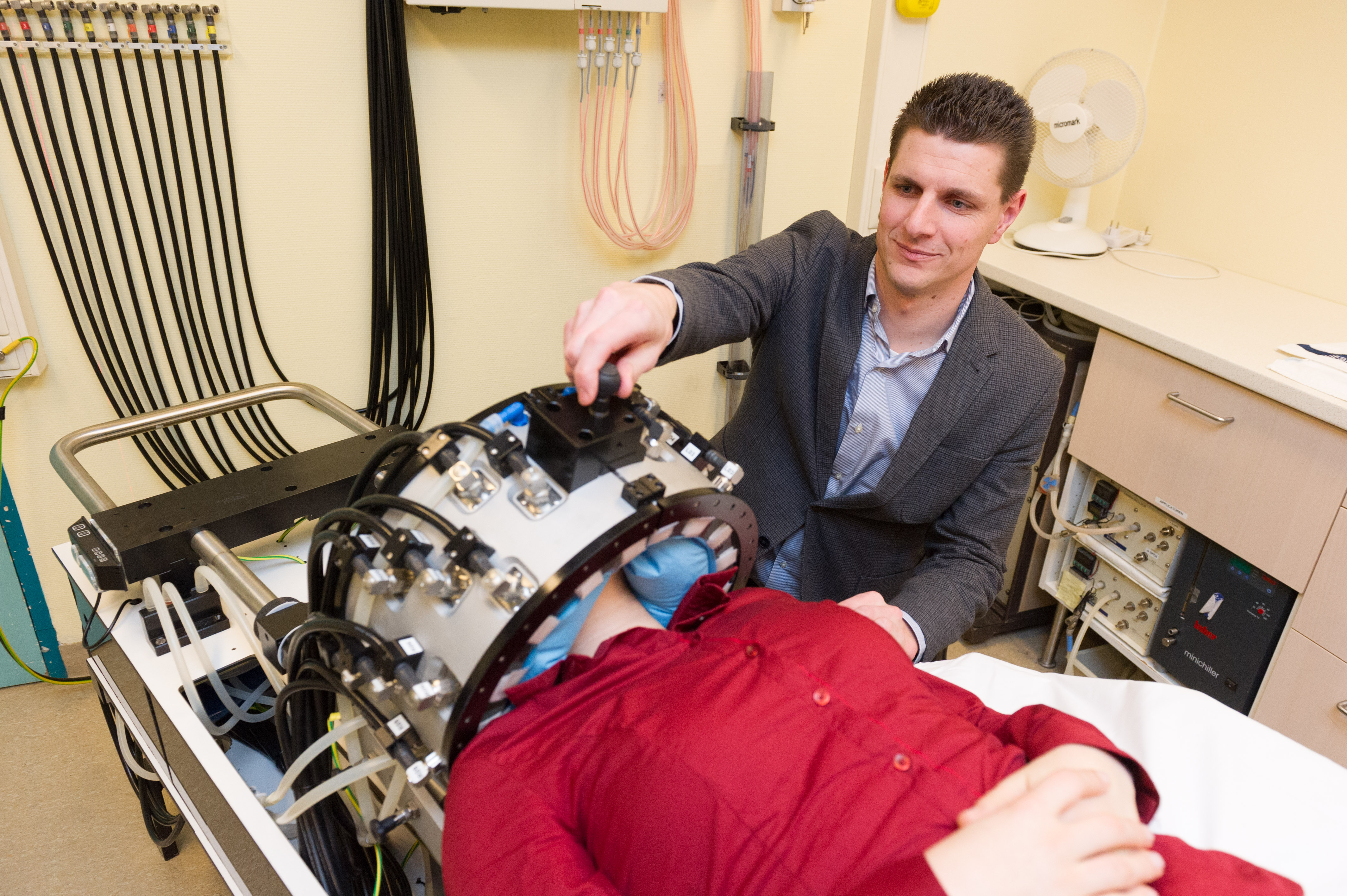
The development of the HYPERcollar, and later HYPERcollar3D, illustrates this evolution. Early work focused on computational modelling and patient-specific treatment planning. As the technology matured, the need emerged for validation in patients. This led to the integration of MR thermometry, model-assisted temperature reconstruction, and eventually MRI-guided hyperthermia concepts. Each step required expertise from different disciplines and organizations, including engineers, physicists, imaging scientists, clinicians and industrial partners.
In our own work, this evolution extended beyond treatment planning to MR thermometry, model-assisted temperature reconstruction, MRI-integrated applicators, tissue property inference and the development of patient-specific biophysical models. Together, these efforts share a common objective: continuously reducing the gap between model predictions and observations obtained in real patients.
The same pattern is emerging across biomedical electromagnetics. Exposure science increasingly combines simulations with real-world measurements. MRI safety relies on both computational modelling and clinical validation. Neuromodulation is moving toward model-informed targeting combined with physiological measurements. Across all these domains, progress depends on the ability to connect modelling, measurement, validation and clinical implementation.
This is why ecosystems matter.
The most impactful advances in my own career did not emerge from a single model, device, measurement technique or discipline. They emerged when these elements were connected. Looking ahead, I believe the same will hold for biomedical electromagnetics as a whole. As we move toward personalized and adaptive interventions, ecosystem building is becoming inseparable from scientific progress itself.
Not because collaboration is fashionable, nor because funding agencies encourage it, but because the next scientific questions can no longer be solved within individual laboratories. The challenge is no longer simply to build models. The challenge is to create learning systems in which models, measurements and interventions continuously improve one another.
For this reason, the future of biomedical electromagnetics will likely be shaped by ecosystems capable of generating and sharing high-quality data, developing mechanistic models, validating predictions in real-world settings, and translating insights into clinical practice. The next wave of biomedical electromagnetics will not be driven by better models alone or by larger datasets alone. It will be driven by ecosystems capable of continuously connecting prediction, measurement, validation and adaptation in real-world healthcare settings. In biomedical electromagnetics, ecosystem building is therefore not separate from scientific progress; it is increasingly part of the scientific method itself.